Open models19 Jul 2026 · 7 min read
Should your product run on an open model? A founder's checklist
Open models hit frontier quality this summer, but that answers the wrong question. Whether YOUR product should run on one comes down to seven checks: quality fit, license, cost curve, data rules, supplier risk, switching cost, and regulatory fit.
Open models17 Jul 2026 · 9 min read
The month open models caught up: Kimi K3, Inkling and GLM 5.2
In four weeks, open weight models went from a few months behind to benchmark parity: Kimi K3 topping arenas, Mira Murati's Inkling under Apache 2.0, GLM 5.2 at a fifth of frontier prices. What actually happened and what it changes.
Open models15 Jul 2026 · 5 min read
The real price of a free model: self hosting maths for a small business
Open model weights cost nothing to download and thousands a month to run well. The 2026 break even numbers, the hidden staffing cost, and the cheap third option most founders should pick instead.
Open models13 Jul 2026 · 8 min read
Open weight is not open source: the license trap in the model gold rush
Kimi K3 tops benchmarks under a Modified MIT license, Inkling ships Apache 2.0, and founders keep calling both 'open source'. The differences decide what you can legally build. A plain guide.
Offline tech12 Jul 2026 · 7 min read
Built for concerts, drafted by democracy: why offline messaging matters every time the internet goes dark
Mesh messaging apps are designed for festivals, flights and mountain treks. Then a government cuts the internet around a protest and the same technology becomes civic infrastructure. How shutdowns work, what mesh can honestly do, and why we are building Beepeto for the boring cases.
Teardown2 Jul 2026 · 9 min read
What building five Ai products at once taught us
Real numbers from a five product Ai portfolio: $0.0013 per scan, a $7.60 ad pipeline, one killed Samsung app, and the Ai slop trap we hit three separate times.
Comparison2 Jul 2026 · 8 min read
ChatGPT wrapper or custom Ai product? How founders should decide
Thin Ai wrappers run 25-35% gross margins while deep vertical ones hold 60-75%. Where the line really sits, with real routing and cost numbers from our own products.
Guide2 Jul 2026 · 8 min read
How long does it take to build an Ai MVP in 2026?
2026 benchmarks put a realistic Ai MVP at 10 to 20 weeks. Our own builds went live in 2 days to 3 months. Where the time really goes, phase by phase.
Guide2 Jul 2026 · 8 min read
What data does your Ai product actually need before you build?
Gartner predicts 60% of Ai projects without Ai ready data will be abandoned through 2026. What founders really need: not training data, but four humbler kinds.
Guide2 Jul 2026 · 8 min read
Will customers find you when search is ChatGPT?
Ranking top-10 on Google now overlaps with Ai citations just 17-38% of the time. What founders should change: generative engine optimization, explained with data.
Content9 Jun 2026 · 9 min read
Ai workflows for content creation in 2026: why they matter and what the credits actually cost
Over 80% of marketers now use AI for content (HubSpot, 2026), yet credit pricing stays opaque. Real costs per asset for images and video, the platform markup math, and why repeatable workflows beat ad hoc prompting.
Costs19 May 2026 · 9 min read
AI app development cost in 2026: credit builders vs custom, with the numbers nobody puts on the pricing page
Lovable, Bolt, Replit, Emergent and v0 all moved to metered credits between 2025 and 2026, and failed generations bill like successful ones. The real cost picture for both paths, with sources.
Robotics6 May 2026 · 8 min read
Connecting ROS 2 robots to LLMs: what actually works in 2026
From NASA JPL's ROSA to NVIDIA's GR00T models, the ROS 2 + LLM stack has matured fast. A practitioner's map of the frameworks, the architecture that works (LLM as orchestrator, never controller), and the safety line you don't cross.
Buying guide21 Apr 2026 · 7 min read
Choosing an AI development partner in Ireland: costs, grants and the questions to ask
Only 20.2% of Irish enterprises used AI in 2025, and the small business gap is wide. A Dublin studio's guide to picking an AI development partner in Ireland, with the actual grants that fund the work.
Engineering8 Apr 2026 · 7 min read
Spline 3D in Next.js without killing performance: what we learned shipping it
A field guide to running Spline scenes and WebGL shaders in a production Next.js site: pausing offscreen render loops, loading screens driven by real signals, reduced motion, and the measurement bug that cost us an evening.
Ai native24 Mar 2026 · 7 min read
Agentic workflows, explained by people who ship them
Gartner expects 40% of enterprise apps to carry task specific agents by end of 2026, and 40% of agentic projects to be cancelled by 2027. The difference is design. What agentic workflows actually are, minus the vendor fog.
Engineering10 Mar 2026 · 7 min read
PWA vs native for Ai first apps: what we chose for our own product and why
Starbucks' PWA is 99.84% smaller than its iOS app. Twitter Lite cut bounce 20%. Here is the 2026 state of PWA vs native for AI products, and why our own app ships as an installable web app first.
Buying guide25 Feb 2026 · 6 min read
Custom AI vs off the shelf SaaS: a build or buy framework that won't waste your budget
Most reviewed AI projects cost $10,000 to $50,000 (Clutch, 2026). Here is the build or buy decision framework we use with clients, including the cases where we tell people not to hire us.
Teardown11 Feb 2026 · 8 min read
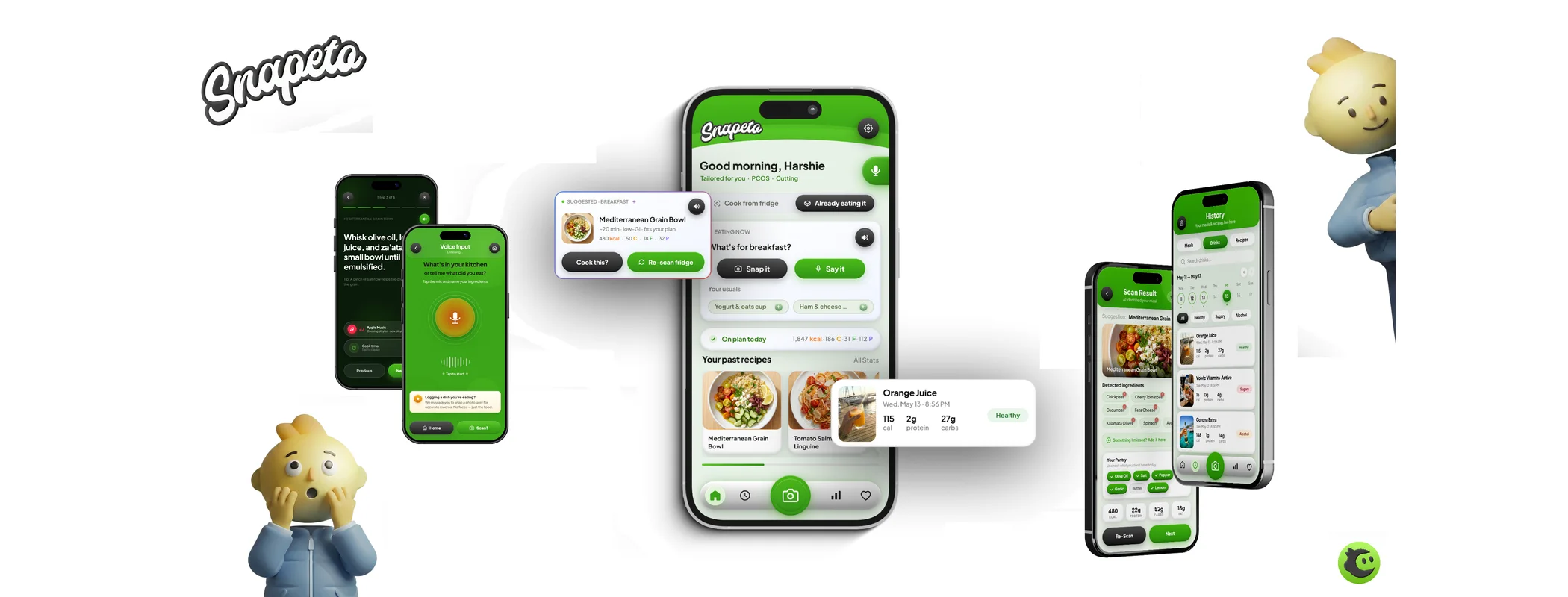
Building Snapeto: a teardown of an Ai native product
How we built Snapeto, our AI recipe and food planning app: the fridge photo capability test, why the camera button owns the home screen, time aware design, and the failure handling nobody sees.
Process27 Jan 2026 · 6 min read
We design, we build, we deploy: how a studio wearing two hats ships Ai native products
The three step process Dinimiciuil Labs uses to take an AI product from idea to production: design around the model, build the full stack, deploy and keep owning it. With the real artefacts from our own builds.
Ai native14 Jan 2026 · 7 min read
What is an Ai native app? The difference between AI inside and AI bolted on
An Ai native app is designed around a model's capabilities from the first wireframe, not retrofitted with a chatbot. Here is the working definition we use to build, with a checklist to spot the difference.